
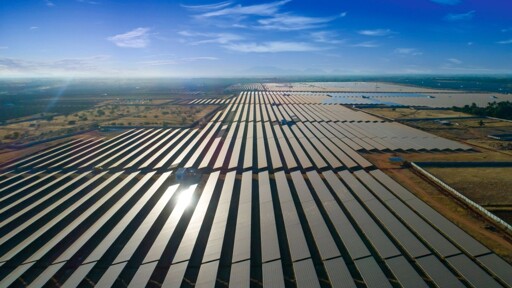
Yes, but have you considered that using renewables means you’re gay? Checkmate liberals.
But what happens after that up front cost?? With the current price of a barrel of sun, can we really afford to limit fossil fuels?
I bought a 1 kg rest mass barrel of sunshine, and… boy howdy, for the price I might as well have purchased 1.8 times 10^15 joules from the energy grid.
1kg rest mass of sunlight in a barrel is objectively horrifying lol. Napkin math says thats ~9e19J. For reference, Tsar Bomba, the most powerful nuclear weapon ever detonated on earth, produced ~2.1e17J. You’ve got a barrel containing ~440 Tsar bomba detonations
I’m glad it doesn’t exist. That committee trying to design warning signs for permanent nuclear waste storage would have a field day. “The inner lining is only 99.99999999999999999999999999% reflective while it’s in this certain temperature range. Do not inhale or exhale forcefully in the vicinity.” is a non-starter.
You don’t measure sun in barrels. It comes in bars.
So do I.
How many?
All of them.
That creates a logistical problem.

Yeah but you have to pay for the sunshine every year that you use to power the panels. And you have to build pipelines to transport that sunshine from the faraway places where it’s developed, and sometimes you have to liquefy it a load it onto gigantic tanker ships and carry it overseas, and there’s always a risk of it exploding and…oh, wait. I’m thinking of the gas. Never mind.
To be fair, NG was sunshine at one point.
Think of all the sunshine jobs.
Probably true in every market that is not the US, with extreme tariffs and EOs banning solar technology.
This is true when comparing to peaker gas/coal plants which are less efficient than more expensive Combine Cycle plants, though both can still run 24/7. The myth of baseload as a requirement ignores that “outside of heating or extreme summer night heat” night demand is half of day/evening demand.
Batteries are now extremely cheap as well, and certainly the combo compared to Combined Cycle is cheaper for better baseload coverage because combined cycle/baseload must overprovide daily needs by meeting peak demand, while solar+batteries can better cover full day needs.
The absolute clincher though is price certainty for 30 years. Free from extortion or geopolitical oppression/chaos of fuel supply chains. Global warming has direct costs to property values, insurance costs, and food scarcity. US policy has moved to create global fuel scarcity for increased dependence on US, as well.
BuT wHaTaBoUt WhEn ItS cLoUdY!!
What about just night?
At night I run off my battery. I can’t go completely off-grid, the days are simply too short in winter, but for like 70% of the year I get free electricity.
In the winter months it still gives me an advantage because I can buy energy at the lowest price point of the day (i.e. when demand is lowest relative to production).
It also allows me to sell the over-production of my solar panels at the most expensive part of the day. And it’s all handled automatically by the software in my solar system. It takes into account the prices over the day, the predicted energy usage during the night, the weather prediction for the next day and uses that to determine when and how much to sell back to the grid and/or when to buy electricity from the grid.
Get ready for “Economic rationalists” having a meltdown in 5… 4… 3…
The propagandized will continue parroting their fossil fuel talking points and will continue to vote for the politicians that collect fossil fuel money.
Why do you say it like it’s an eternal inevitability? Propagandists spend so much time and money on propaganda because it has to be maintained at a certain pressure to effectively change someone’s behavior. The solution to the propaganda problem, then, is to combat propaganda, not wring our hands in despair. We’ve been busting up propaganda rings since the dawn of the written word, it can be done. Just needs people to do it.
Propagandists spend so much time and money on propaganda
Your mistake is believing that they are spending much money. It’s actually a small fraction of the money they make from burning the planet, miniscule if compared to the amounts accumulated over decades, and it’s also the easiest option. They could also just buy politicians who are incredible cheap but still more expensive than the ongoing media desinformation campaign that mostly runs on its own because the clickbait industry journalism has become runs on stories the propaganda victims want to hear.
I guess it depends on what you call much. influence campaigns are clearly profitable, at least some of the time, but just because the profits are greater doesn’t mean the costs aren’t still significant.
And, I think the more active people are in countering propaganda, the more expensive it becomes to achieve the same effect. I think just believing the effects of propaganda are inevitable (and acting on that belief) has the effect of making deception that much more economical and effective for those who wish to deceive for their own selfish ends.
I think the more active people are in countering propaganda
Oh, so you never actually tried to talk to those lost propaganda victims conditioned to reject facts (because otherwise they wouldn’t fall obvious bullshit anyway) and can’t be convinced of reality anymore?
Of course I have. That’s exactly what I’m talking about. That’s a fair description of most of my family and most of my hometown, I would be hard-pressed not to.
They already moved on to different tactics like restricting the ability to connect solar to the grid or simply burying all applications in red tape for years.
Idk, it’s working pretty great for me.
My experience: https://lemmy.world/post/32326227
But you are not scalable.
The companies that in my country have already applied for grid connections of more solar and battery capacity than would be needed in the next few years yet waiting and waiting and at some point just giving up would be.
Oh, and now law changes will also kill all future plans as no one will build any more solar with their own money (or get loans from banks) after the decision if they can actually feed in their produced electricity is shifted to the control of grid providers all-well connected or subsidiaries with fossil-fuel focused energy companies.
Economic viability means shit if it gets fought actively on the government level.
they are going pretty hard in maintaining gas and oil production
We could use the excess power to bank carbon, then if we need more power we can burn that same carbon.
Edit: This isn’t to be efficient, it’s to remove carbon from the atmosphere and reverse global warming. I meant that being able to use it as emergency fuel would just be a perk.
Seems super complicated when you could just pump water up a hill, then open a dam when we need more power.
Have you tried boiling water?
Jokes aside:
Instead of boiling that water to run a turbine perhaps we could use a Thermal Electric Generator to extract energy without said turbine and everything that comes with it.
Dont know how well this would scale or what it’s hard use limits would be. But I hear a common solution to “too much solar” is to run the excess energy into heating a pool.
A Thermo Electric Generator could allow people to recapture that energy in their pool.
Heat pumps work like this. They pump heat into the ground during hot months, then take some of it back during cold months.
Hear pumps do this, but they pump energy into the ground during hot months to cool the house, then during cold months they pull some of it back.
Pumped hydroelectric storage is really hard to do at scale, because gravitational potential energy requires a gargantuan amount of mass raised a very tall height.
A containerized battery storage system can fit up to 5 MWh of storage in a single 40-ft shipping container. 5MWh is 18 gigajoules, or 18,000,000,000 joules.
Raising 1 kg (or 1 liter of water) by 1 meter stores 9.8 joules of gravitational potential energy. So you need to scale this upwards and find 1.8 billion to fit into mass or height in order to match the storage of one measly shipping container battery system. So basically any gravity storage system needs very favorable geography, and can’t really scale the way that battery storage systems can.
Right, but I was comparing pumped hydro electric to carbon capture for fuel…
I’m still hopeful for synthetic hydrocarbon production from power-to-liquid Fischer-Tropsch processes, especially the ones that convert captured CO2 and H2 into kerosene for jet fuel. That same 5 MWh/18 gigajoules of energy I was discussing in my earlier comment can be stored in about 390 kg of synthetic kerosene, at 46.4 MJ/kg.
There’s no doubt that it will require a lot of technological and engineering advancement for carbon capture + hydrolysis + the whole PtL process to approach the round trip energy efficiency of charging a lithium ion battery (90%) or pumped hydro (75%), but if we do intentionally overbuild solar and run the chemical plants at near-negative energy prices based on time of day, it could lead to a more broadly sustainable global supply chain for decarbonizing existing fossil fuel systems (like airplane jet engines).
What about the absurd amount of land it takes?
How much energy can be produced on global land used for liquid biofuels: 32000 TWh for PV vs 1400 TWh biofuels for transport:
Remember that you can still use the land for a more useful agricultural crop with higher¹ or similar² yield³ with agrivoltaics
You can also put panels over parking lots. USA alone has more parking lot land area than some countries:
Biofuels: the least efficient form of solar power one could possibly invent.
It’s fine if you have ample fields and a low population with an excess of food.
It’s mainly there as a form of farm subsidy that bypasses restrictions thrown up by long-existing trade agreements. Canada provides no farm subsidies besides underwriting crop and moisture insurance premiums to an extent, but the US has a long history of flouting these restrictions.
As usual. Coincidentally it provides money for equipment manufacturers and inputs providers like Deere and Cargill. But I’m sure that’s just a happy coincidence of providing “food security”.
can be leased, and at end of lease, land is free for any use. ie. it is not polluted. Fossil plants need exclusion zones for air pollution and noise, and still depress neighbour property values.
If you have the space. Solar needs a lot more space for the same power output.
Sticking coal power generation on your roof, are ye?
From a power-generated-per-area perspective, PV is about 500x less dense than a modern gas-fired combined cycle.
Why does that matter? Solar can go where coal can’t.
Put PV above a parking lot, you’re not using that land for anything else useful anyway.
Lotta places it can go. Doesn’t matter if it takes up more space.
Coal and gas plants can only go in specific spots. Need a water supply, needs logistics, needs a clear zone to vent. So it needs more space than a trivial accounting would indicate.
Solar can go in more diverse locations, absolutely. Especially advantageous because solar can be installed right on top of the buildings that need electricity. Lowers dependence on already-overloaded transmission lines.
Just from a utility perspective, it’s a lot simpler, easier to buy a plot of industrial zoned land, and stick a combined cycle on it. This is enough to power an entire medium city, 24/7.
Compared to logistically working with a massive number of private property owners to install solar on their property. And the result of all that work is enough to power the same city from 7 in the morning to 7 at night.
From a utility perspective, you may be right. Given the existence of an already-extant fossil fuel distribution infrastructure, I could see it being simpler.
But that said, the “amount of space used” isn’t a great metric to compare the two, since the space used by solar is very different and can overlap with space used for other things.
Getting away from utilities, solar is something that individual people can install on their properties to electrify their own little baby power grid, feeding back to the wider grid or not. This will effect the demand curve in the aggregate, leaving utilities to cover the difference somehow. With load dropping to zero or near-zero during sunlight hours, and increasing in the off-peak and winter hours, they have to consider options to balance the grid that aren’t appropriate for fossil fuel plants.
The niche that gas peaker plants fill is rapidly going away as battery technology improves. I think the calculus, in ten or so years, is going to be that it’ll be “a lot simpler, easier to buy a plot of industrial zoned land, and stick a” battery farm on it to harvest surplus power during the daylight/windy hours and discharge it at other times.
I expect that demand for gas is going to drop precipitously in that situation, meaning that the whole fossil fuel distribution network may struggle, and prices will go up, further motivating distributed generation. And utilities are going to want to prepare for that earlier rather than later.
Agreed, energy density isn’t really very relevant from a grid perspective; space is pretty abundant when you’re talking about an entire grid region.
I was definitely hinting at the dispatch-ability of PV in my other comments, but you totally have the idea.
And it’s going to be batteries totally. At the publicly owned power utility I work at, I actually was in the energy storage technology group for a small stint. Whole purpose of the group was just running feasibility analyses on installing utility-scale batteries.
The core issue is batteries at scale are a completely infant technology. We had proposals that were literally straight out of graduate research. That’s great and all for the technology development, but my company only cares about reliability, dispatch-ability, and competitive rates. We’re not interested in prototypes.
I’d keep a close eye on molten salt batteries and flow batteries. I think those are the most developed. Especially flow batteries, companies like Sumitomo are making pretty big progress in Japan, and starting to move over to the US.
But again, issue is scale. A useful battery for a medium-sized utility is something like 50MW at 4 hours duration (equivalent to something like a peaker unit, though not all that useful for nighttime baseload). And this battery would be something in the range of like $250M. And a comparable gas peaker unit, about $80M, and that unit can run 24/7.
So the economics at utility scale are getting there, but we’re not there yet.
I do look forward to a 99% solar and battery grid though. With that 1% filled by emergency natural gas.
Are you counting the space taken up by the gas wells, transportation infrastructure, and storage facilities?
We have space on our houses, to protect us from rain and sun.
Btw, why are never company buildings solar required? They have vastly more space.
Completely ignoring the mining part
It’s not the same, since it’s not dispatchable. So you need gas turbines or very large battery systems for backup, which isn’t exactly helping with that upfront capital.
The backup for turbines and coal plants failing is more turbines / older, less efficient turbines though, right? If our existing power infrastructure is spun up overnight only, that’s a huge improvement. Turbines for flexible capacity will always be a thing, but solar to provide baseline capacity is just good business.
There’s another strategic benefit: batteries have a fixed cost that doesn’t rely on a variable input cost. With current events in the strait, countries without abundant natural gas are advantaged because they’re less reliant on geopolitical conditions. This is why we’ve seen such growth of solar in china, which is not oil-rich, and was already importing a lot of coal.
Major issue with spinning up turbines over night is the actual gas turbine unit ramp rates. Meaning how quickly they can go from cold and offline to hot and full output. Some units take upwards of 8 hours to get to their full output.
And the peak load of an average grid is right when the sun is setting and everyone is getting home from work, around 5 in the afternoon.
At that time, solar is dropping fast, and you don’t have time to start up your slow units, they’d have to already be online.
So utilities are often forced to leave their gas units online, even when solar is pumping out power, just to have them ready for the peak demand (and also have them for night).
Solar was the cheapest source of power YEARS ago. Solar plus storage was also the cheapest form of dispatchable power years ago, but for some reason these idiots are just reporting it now.