

151·
21 days agocomplete dealbreaker issues
.
inability to use 240hz
Opinion disregarded

I make things: electronics and software and music and stories and all sorts of other things.
complete dealbreaker issues
.
inability to use 240hz
Opinion disregarded
More like gaming executives

Not currently, but that was an explicit choice, so it’s easy to change
Maybe I should add a flag to allow searching for h files when building C++
Update: I went ahead and implemented the multithreading
Update: I went ahead and implemented the multithreading

You can build with mingw64 built with msvc and use more or less the same Makefile. As for Xcode… well, there’s not really a good reason to support Mac. On principle I wouldn’t even try
How the heck does a Makefile not scale??? That’s all it does!
Life is and will always be better writing your own Makefiles. It’s literally so easy. I do not get the distaste. Cmake is arcane magic. Bazel is practically written in runes. Makefile is a just a glorified build script, but where you don’t have to use a bunch of if statements to avoid building everything each time.
And yeah I know about NixOS but I like to distro hop and experiment
If you know about NixOS, then you probably know this, but Nix, the package manager/the language behind NixOS, is cross-platform.
I daily drive NixOS, but I also use Nix (and home-manager) on my Fedora music laptop, my Ubuntu home file-server, and my work Windows machine (WSL) to install and configure neovim automatically instead of copying a config, installing all the packages, and running check health over and over again until everything is set up.
I just copy my neovim.nix file over (also other things like zsh.nix) and run home-manager switch
You don’t have to use NixOS to take advantage of its benefits.
Ext4 bc of its speed for games and my main files. Btrfs on the root for compression

It’s a bit more than iced as they’ve created a library on top of it, esp for the theming they desire
Build a project. Learn how to do each step by searching the internet. It’s quite literally that easy.
For C++, yes. But “reference” is just a way of using the pointer when it comes to C
You can use VS Code and Vim/Neovim for any language, as well as document writing and basic text editing. Just search for Go plugins
It shouldn’t be hard to use either. If it is, you’re doing something wrong probably

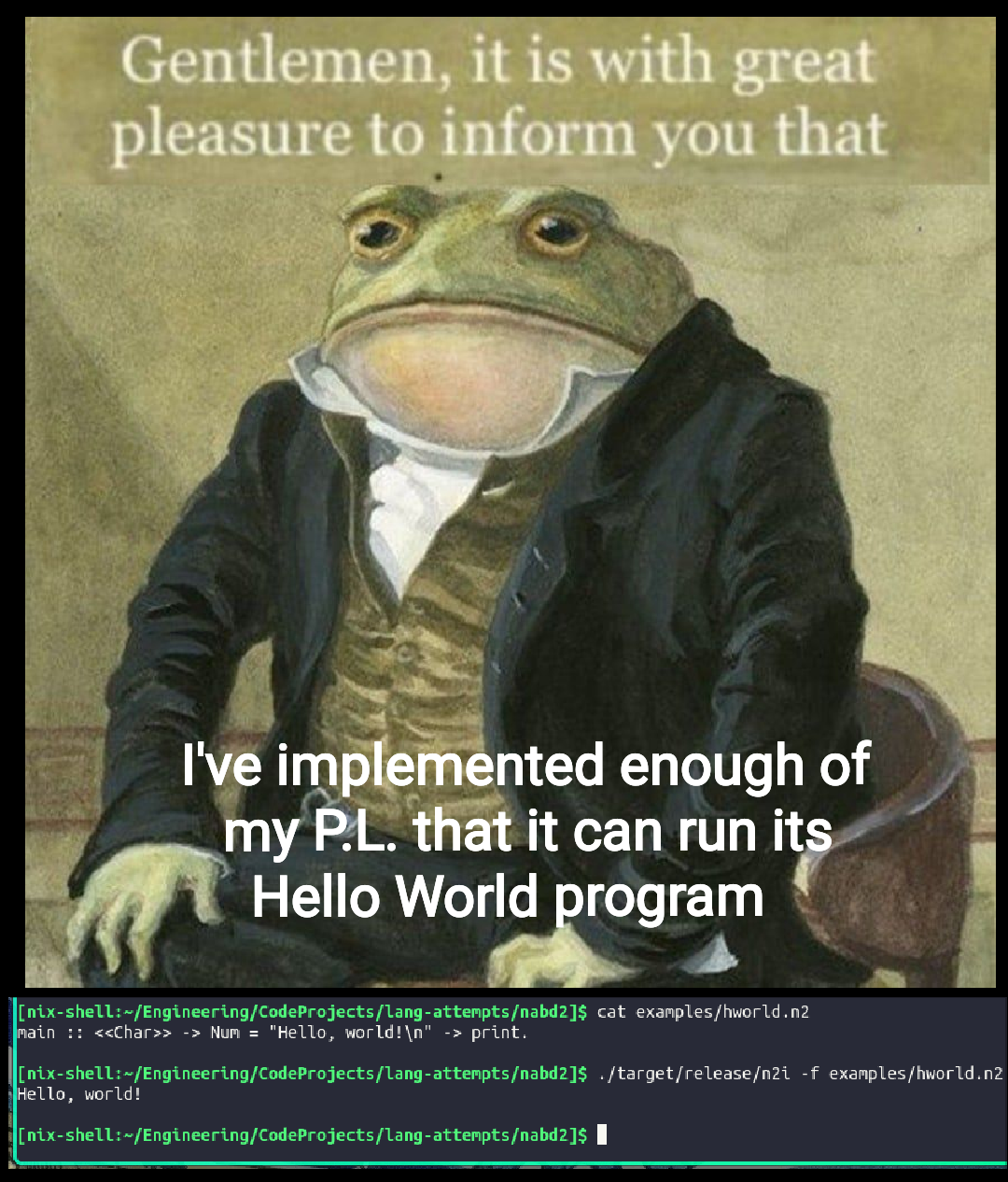
In case you’re interested, the language is a derivative of an esolang I made called NaBD. The idea was a Turing tarpit but for functional languages. What’s the minimal I could get by with and still feel like a real language? (And no, not just lambda calculus; needed a real implementation)
I realized this sort of stripped-down functional language would make a great basis for a graphical programming language, something I’ve wanted to make for a while, so I set out to refine and remake it into just that.
That’s why the syntax is a little bizarre, bc it mimics the flow of graphical blocks. It also is very simple. Every function has one input and one output with no first class funcs/currying. It’s also statically typed.
Here’s a truth-machine (doesn’t work yet bc I haven’t implemented some of the standard functions; it does parse and type check tho at least):
truth_mach :: Num -> Num =
    { inp -> bool,
        1 -> str -> print -> truth_mach,
        0 -> str -> print } -> if.
main :: <<Char>> -> Num = read -> parse -> truth_mach.
It will also support the C ABI via extern_c name_of_lib : name_of_function :: Type -> Type. This is not implemented yet either.

ctrl + x => :wqa
ctrl + s => :w
Just switched to LibreWolf/Mull + KeePassXC/KeePass2Android
Tuta Mail for personal
Thunderbird/K-9 (mobile) for my work’s gmail since the gmail website is garbage
Nvidia and Wayland is still BORKED
Nope





I find Rust crates generally have pretty good docs. Docs.rs is a major time saver