Where I am, there’s a requirement for 15% (I believe) of new condo developments to meet accessibility standards. You wouldn’t believe how people—potential buyers, not developers—are against that, saying it’s too many. That’s just new developments. All the existing old stock is not accessible, so that percentage of total accessible living spaces is, actually, still tiny. But it’s still too much to accommodate accessibility.
Literally everyone is one accident, illness, or old age away from being disabled in some way. I can’t believe how stupid and short-sighted people are. (Maybe that’s their disability.)
Literally everyone is one accident, illness, or old age away from being disabled in some way.
yeah I was surprised to come across the statistic that in the UK about quarter of the population has some kind of disability (defined as “a physical or mental health condition or illness that has lasted or is expected to last 12 months or more, and which condition and/or illness reduces their ability to carry out day-to-day activities”)
Where I am, there’s a requirement for 15% (I believe) of new condo developments to meet accessibility standards. You wouldn’t believe how people—potential buyers, not developers—are against that…
I’m against that!
It should be 100%. There’s no excuse not to use universal design principles in every new building.
I was just thinking about the student apartments I lived in. They were 2-storey with wooden staircases up to the second floor. They were built in 4-apartment units; so figure the left apartment is mirrored on the right, with a mirrored pair stacked on top. These were 50% wheelchair accessible, to make them 100% you’d have to install like 16 2-storey elevators. Again this is student housing, they had some deal where you had to prove enrollment in a college or university to take out a lease, and so they had pretty quick tenant turnover. So what you do is fill up the second floor first, keeping spots open on the ground floor for disabled students as much as practicable.

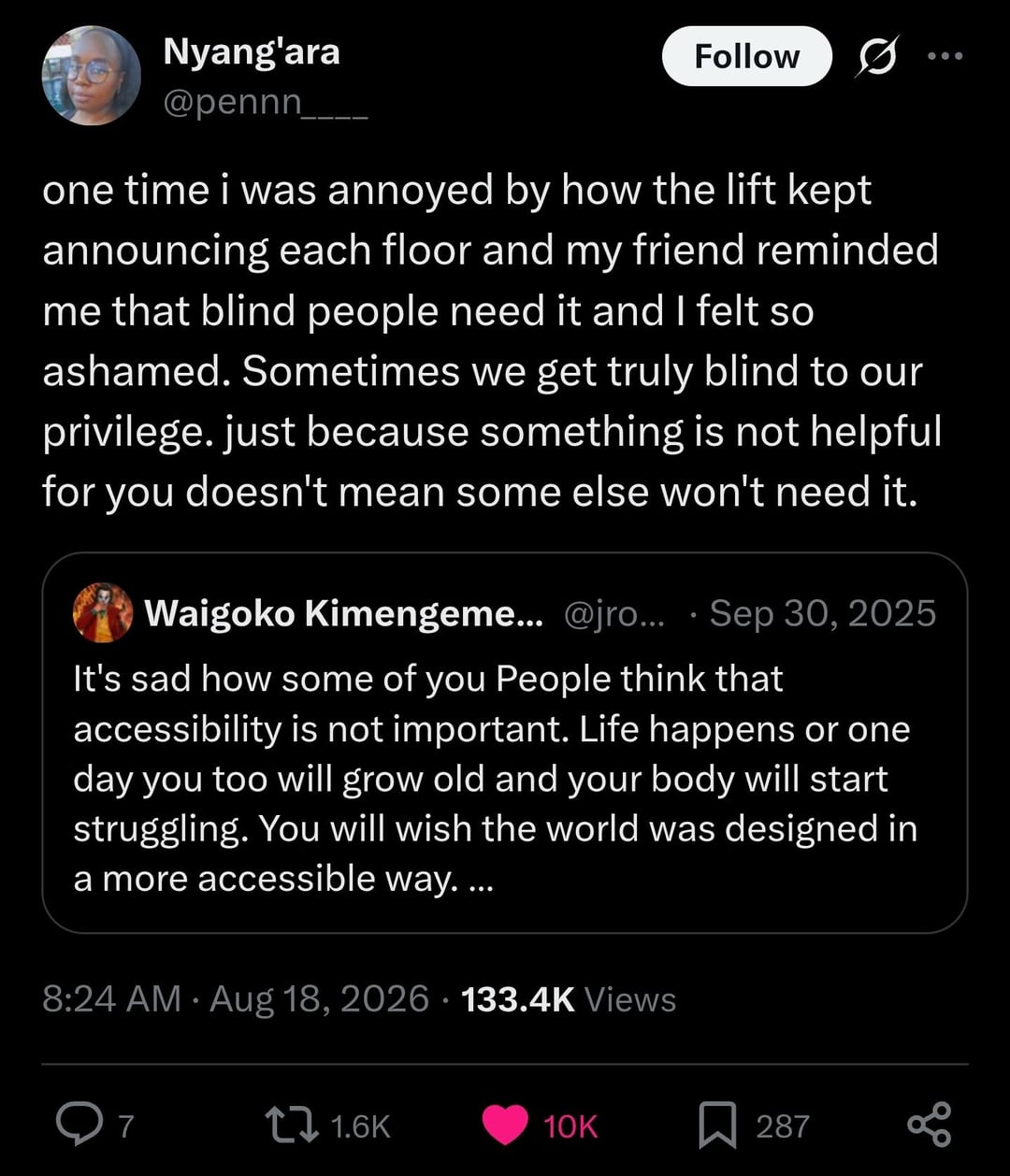
Where I am, there’s a requirement for 15% (I believe) of new condo developments to meet accessibility standards. You wouldn’t believe how people—potential buyers, not developers—are against that, saying it’s too many. That’s just new developments. All the existing old stock is not accessible, so that percentage of total accessible living spaces is, actually, still tiny. But it’s still too much to accommodate accessibility.
Literally everyone is one accident, illness, or old age away from being disabled in some way. I can’t believe how stupid and short-sighted people are. (Maybe that’s their disability.)
yeah I was surprised to come across the statistic that in the UK about quarter of the population has some kind of disability (defined as “a physical or mental health condition or illness that has lasted or is expected to last 12 months or more, and which condition and/or illness reduces their ability to carry out day-to-day activities”)
I’m against that!
It should be 100%. There’s no excuse not to use universal design principles in every new building.
I kind of get it, in a tiny flat, making everything wheelchair accessible means objectively worse space usage for a non disabled person.
Solution is to just not buy it if you don’t like it though.
I was just thinking about the student apartments I lived in. They were 2-storey with wooden staircases up to the second floor. They were built in 4-apartment units; so figure the left apartment is mirrored on the right, with a mirrored pair stacked on top. These were 50% wheelchair accessible, to make them 100% you’d have to install like 16 2-storey elevators. Again this is student housing, they had some deal where you had to prove enrollment in a college or university to take out a lease, and so they had pretty quick tenant turnover. So what you do is fill up the second floor first, keeping spots open on the ground floor for disabled students as much as practicable.