
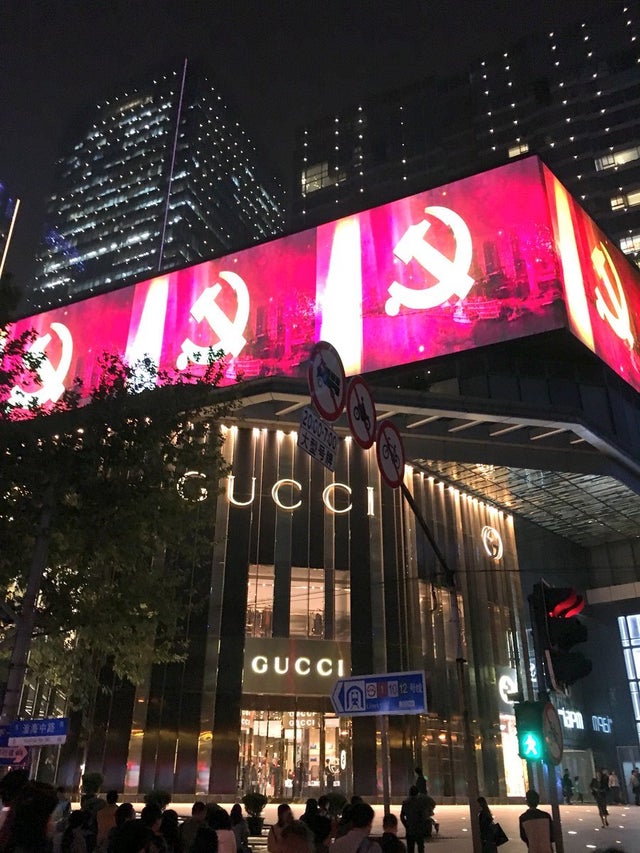

Source https://lemmy.zip/post/72029200/29026430
Join the lemmy.ml boycott today and help foster a better Lemmy-verse! No more posts, comments (except to counter their propaganda ofc!) or upvotes on any comms on the Lemmy.ml instance! To make this easy you can do an instance block at Settings > Block Tab > Scroll to bottom > Input “lemmy.ml” and apply
And consider donating to individual instances instead.
Check the megathread for more!
I don’t think either are, but any definition that includes the US that is reasonable will likely include china.
if you don’t want to have a dialog with people you disagree with and just close your ears what good will that accomplish?
if you’re not even willing to engage with that question how can you be certain it’s correct? why don’t you just have a throwaway copy-paste ready to fight against it? would be more fruitful if you actually care about dismantling that idea? what you did right now won’t convince anyone.
Ok, well I’m slightly encouraged that you don’t think China is democratic, that’s why I thought this discussion was a lost cause.
My definitions for a democracy are pretty straightforward, the people get to either decide the laws of their policies of their government (i.e. ballot initiatives, which are a major part of US government, at least at the state level), or decide who represents them in that government by voting. The elections should be free and fair, and candidates should not be restricted based on their platforms or ideologies. I think that’s a pretty uncontroversial definition.
I strongly disagree with your statements about China being freer than the US on the policies I mentioned. I figured you wouldn’t like whatever expert rankings I provided… I didn’t actually know Freedom House was funded via the state department, but as far as their impartiality goes, consider that per Wikipedia they got their funding through USAID which has since been slashed, and also conservatives in the US don’t like them because they think they’re anti-conservative. But anyways, here’s another few for you:
https://patrickrhamey.com/saturday-research/2025/8/14/2025-state-of-world-liberty-index EDIT: this one at least partially uses Freedom House damnit
https://www.cato.org/human-freedom-index/2025
https://v-dem.net/data_analysis/CountryGraph/
I’m not cherry-picking these, I’m literally just searching for civil liberties rankings. They’re all fairly consistent. If you can find one that shows China above the US with independent authors, I’d be interested to see it.
Just to be clear, I don’t think these indices are of any value at all? This isn’t something that can be measured by a single value, you have to go point-by-point and use actual arguments, but no on Cato
I’m having trouble finding v-dems actual arguments about this
I again have to ask how you think elections in china work, do you deny the existence of their elections? Which parts of your definition does china not meet? I’m not saying they obviously do meet them, i’m wanting to know what you’re really saying about china, obviously they have a preference for ccp for example, i’m not denying this, just asking you how china works, according to you.
I don’t really like that definition because it ignores what’s really important: are the majority getting what they want? Your definition is more like guidelines for achieving that and thus puts the cart before the horse, I could accomplish all of these things, and still make it such that the majority don’t get what they want.
Not sure what you mean by that. You can select any single value you want, select the country, and then see the scores over time. Or see the by-country scores with different sections broken out here.
I certainly deny they have free and fair elections, yes. There’s only one party on the ballot - that’s a hell of a lot more than a “preference”. Elections in the People’s Republic of China occur under a one-party authoritarian political system controlled by the Chinese Communist Party (CCP).[1][2] By law, all elections at all levels must adhere to the leadership of the CCP
“The majority getting what they want” is way too vague of a statement to quantify, but generally speaking I would agree that people in America and most of the Western world are dissatisfied with their governments. That doesn’t make them undemocratic. I get your argument - you’re saying that if people aren’t happy with the decisions their government is making, is their government really representing them at all, and therefore democratic? But politicians making unpopular decisions has always and will always be a thing, and to a certain extent it’s necessary - it doesn’t even mean the politicians are corrupt for doing so. With that said, overall, I’d say that most major government policies are politically popular.