

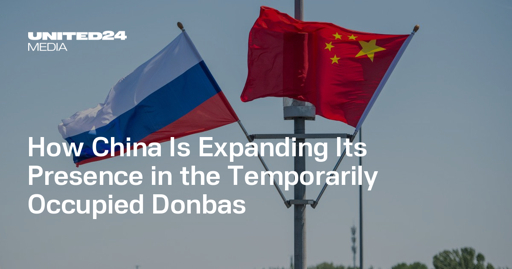
China is expanding its economic and infrastructure footprint in Russian-occupied territories of Ukraine through a series of indirect and largely unpublicized initiatives.
In the Donbas, around 80 bank branches have begun trading in cash yuan. This cooperation includes the exchange of local delegations and efforts toward “import substitution,” all while Beijing officially maintains a policy of not recognizing the occupation of Crimea or the annexed regions, according to the Insider on April 23.
…
For Beijing, these moves may serve a broader geopolitical strategy. Beyond immediate economic gains, the region offers access to strategic resources. Roughly half of Ukraine’s rare-earth mineral deposits, including lithium, titanium, and zirconium, are currently located in occupied zones.
As Russia remains focused on its military efforts and lacks the technology for advanced extraction, Chinese developers may eventually secure control over these critical assets as part of a long-term logistics corridor into Eastern Europe.
In February 2026, analysts from the Independent Anti-corruption Commission (NAKO) reported that Russia had evolved from merely surviving sanctions to using them as a tool for deepening strategic alliances with China, Iran, and North Korea.
…
You can move a lot faster if you don’t care and don’t need to care about any safety or environmental standards. It’s stolen land free to ruin for a quick win.
That’s also how the region’s industry was developed in the first place - Russian Empire and the USSR prioritized extraction from the land of less privileged peoples to the point of depletion and massive environmental damage, before moving on to the land of other colonized peoples currently under the Russian government.