
cross-posted from: https://discuss.online/post/38877381
http://www.smbc-comics.com/comic/quantum-6
Alt text
Later they go out for a superposition of chocolate and vanilla ice cream.
Bonus panel
cross-posted from: https://discuss.online/post/38877381
http://www.smbc-comics.com/comic/quantum-6
Alt text
Later they go out for a superposition of chocolate and vanilla ice cream.
Bonus panel
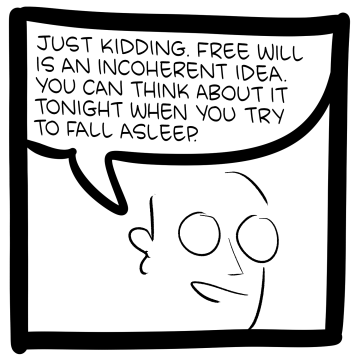
![Quantum [SMBC]](https://discuss.online/pictrs/image/12cdcf9d-eda8-4eed-b025-1eae09419199.png)
Why doesn’t the weather have free will? It seems like a silly question, but actually gets right to the point.
What exactly is the “experience of free will”? To me, that sounds a lot like “I can’t predict my own behavior”, which in turn is exactly “I can’t predict the behavior of X” as above, where X is oneself.
To me, this sounds like it agrees exactly with free will meaning “I can’t predict the behavior of X”. Why is it necessary for free will? Because what you actually mean by free will is “unpredictability”.
The key difference between unpredictability and free will is the experience of free will, which is the opposite of what you say: my experience of free will is that I can predict my own behaviour quite well through my awareness of my own choices, but nobody else has access to that awareness, therefore they can’t predict my behaviour. I am predictable to myself, to an extent, but not to others. Unpredictability can be a consequence of free will, but it is not equal to free will.
With concepts like awareness and choice we of course have the same problem as when discussing consciousness - I can’t strictly speaking know if anything other than myself is conscious, since the main proof of consciousness is the subjective experience of said consciousness. Therefore I can’t strictly speaking say that the weather doesn’t have free will, in the same way that I can’t say a rock cannot experience joy.
But if we work in the relatively sane framework that rocks and weather do not have consciousness, and you and I do, then the experience of making a conscious choice is the central evidence for free will.
If it was proven that the world is deterministic, then I would consider that evidence irrelevant. But in a non-deterministic world, it becomes compelling.
It seems like we agree that it’s observer-dependent, just different phrasing. I also don’t think “access to awareness” is necessary for predicting behavior, depending on what exactly you mean. I think a sufficiently advanced intelligence could predict your or my behavior perfectly.
Why is that a relatively sane framework? It’s a very anthropocentric worldview to just assume that.
As far as we know, an infinitely advanced intelligence wouldn’t even be able to predict the weather a year from now, so I don’t think you’re right. Assuming of course that the brain is more complex than the weather.
I haven’t really encountered any serious framings of the world where a rock can experience joy, but I’d be very happy to know more if you know of any.
I guess ultimately it’s more of an empirical approach than an anthropomorphic assumption - nothing about the behaviour of a rock provides any evidence that it has any sort of awareness or consciousness. On the contrary, the available evidence seems rather consistent with the theory that it doesn’t.
There’s no limit to predicting the weather that I’m aware of for an infinitely advanced intelligence, what do you mean exactly? For complexity, are you saying that the brain must be more complex than the weather to predict it?
Moreso weather than rock, but either one, really. Define “awareness” in an empirically testable manner first and then we can start applying it. Until then, it’s the same as arguing about souls or angels dancing on the head of a pin. Any common definition is circular and meaningless, e.g. “aware” - > “conscious” -> “aware”. Is a thermometer aware of the temperature? If not, why?
Let me try and be very precise: We know that weather is a chaotic system, which means it has a positive Lyapunov exponent, which measures how the uncertainty of a chaotic system evolves as a function of uncertainty in initial conditions.
Usually this just means that our weather models will fail if our initial data input isn’t precise enough. But even if we imagine a perfect weather model, perfect data input and a perfect intelligence to model future weather, the input data is still limited in precision by the Heisenberg uncertainty. As far as we know, something like the position of an atom cannot be known with infinite precision, and a future theory which is more precise (aka a “hidden variable theory”) has been consistently shown to be impossible through the “Bell tests” or “nonlocality experiments”.
So, if we assume that the perfect intelligence still only knows the position of each atom down to say, a precision of one Angstrom, 10^(-10) meters, and we assume a Lyapunov exponent of about 0.5/day, see e.g. this paper, then we can calculate that after two months the uncertainty is approximately
1 Å (ångström) exp(60 days×0.5/day) = 1 km
So even with perfect data, perfect model, perfect intelligence, the location of each atom in your weather model would have an uncertainty of one kilometer after predicting just two months into the future. In other words, there is a fundamental limit to prediction of complex physical systems.
One criterion we could apply is the ability to respond to stimuli beyond Newtonian mechanics. All living humans and animals have this ability, no rock has this ability. It can be empirically tested.
Does the ability to react to stimuli mean that you are aware? Not necessarily. But if you cannot react to stimuli, then you cannot be aware.
By the way, thanks for sticking with the conversation, this is super interesting stuff!