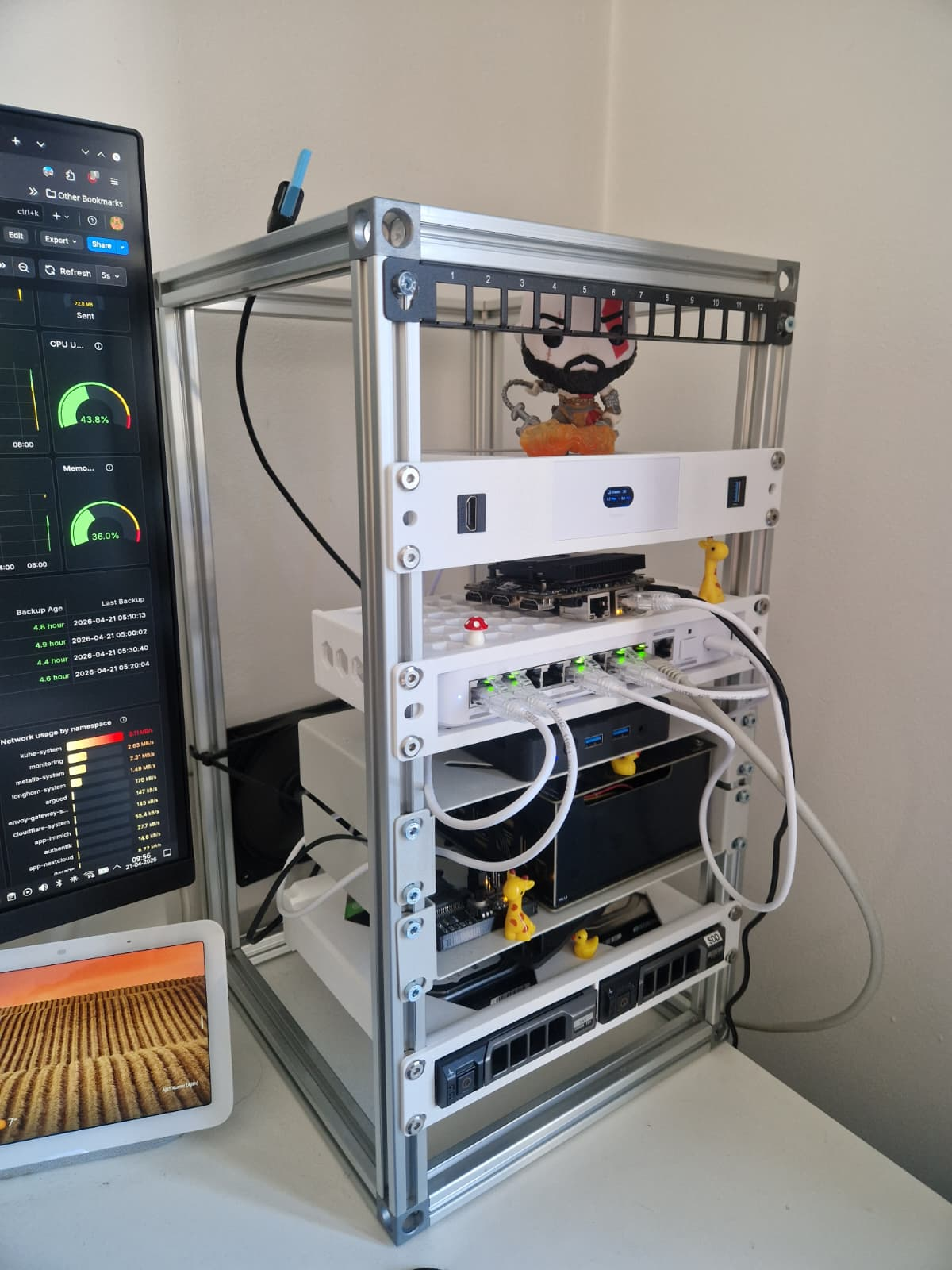

Update to my Homelab, I’ve started 3D printing brackets, and I moved almost everything to Kubernettes
I still have a lot more I want to print, and some custom things I need to design, which I currently have no idea how to do, but keen to learn and figure that out.
This is what’s in my k8s cluster right now:
This my dashboard:
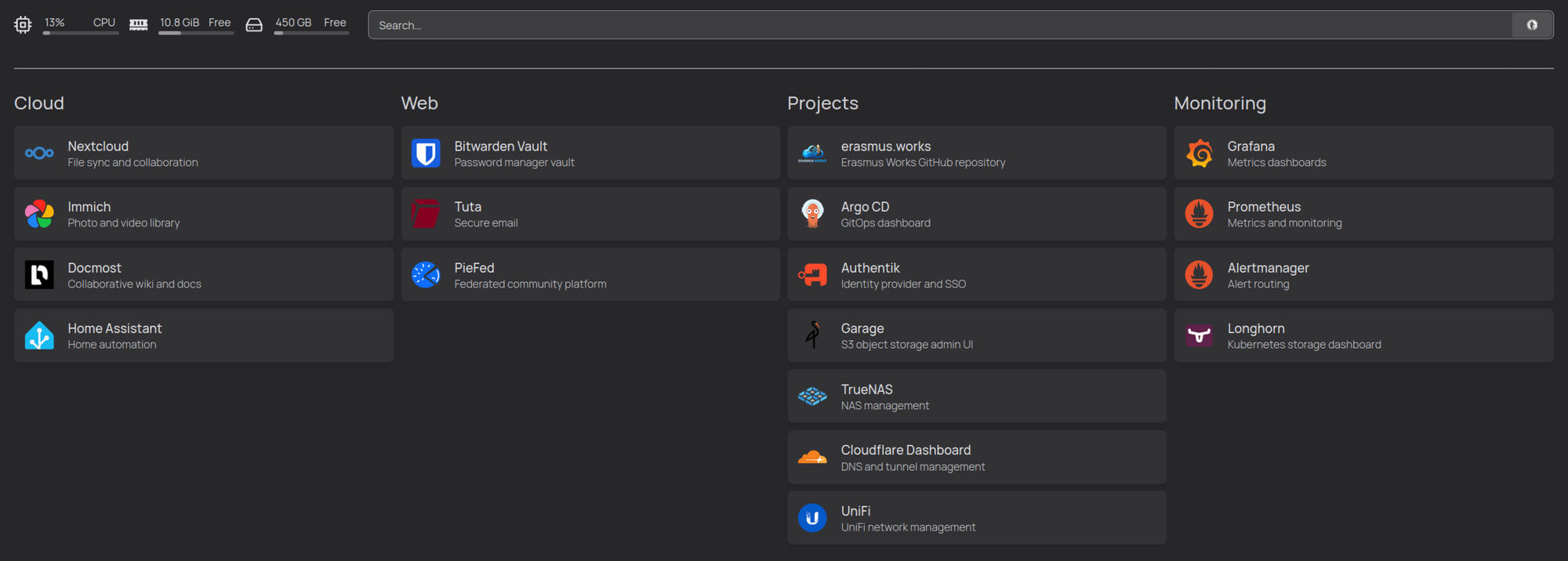
Most of these are app running on my cluster.
One of the main reasons I started this is to be less dependent on Google, Microsoft etc.
Yes I know I use GitHub and Cloudflare, it’s a marathon not a sprint and perfection is the enemy of progress.
So if you came to the comments to scream at me for using GitHub/Cloudflare, please first see This
Old post of how my homelab started, and how things used to be: https://piefed.social/post/1002037
You’ve come a long long way!
Thanks!! And still have a lot to do
Absolutely sick!!! Love this so much. I’m on a journey to have my own homelab via a k8s setup so that I would have project experience and qualifications for a DevOps engineering job. I’ve also seen people use LocalStack to essentially emulate AWS and set up homeland via LocalStack and k8s to get project experience. That’s next up for my list!
Can I ask, what’s the benefit of using K8’s in a homelab? Why not just use docker?
K8s uses docker under the hood, once you have 3 nodes, you can plug out one of the nodes and the whole system will recover and all your services stay up.
I had a SSD fail on me and it brought down Immich and Nextcloud, then they were down for like a week while I did troubleshooting and ordered a new SSD.
Once my 3rd node is up, if a SSD fails I will just get a notification that my cluster is degraded, and I can investigate it while everything stays working.
It’s gross overkill for a homelab, but it’s fun to build and setup.
Kubernetes does not use docker under the hood.
https://dev.to/thecloudarchitect/can-kubernetes-run-without-docker--267b
Kubernettes is a orchestrator for containers.
As your article said, you don’t NEED to use docker.
But in many cases you do use docker, many of the containers I run are docker containers
I think you are mixing up docker with OCI containers.
Docker is a container orchestrator. You can just as easily use podman or Kubernetes
Did some reading, yea you’re right.
So many of the containers run in K8s are built with docker, but the containers themselves aren’t docker.
I think many people (like I used to 10min ago) think that docker = some-kind-of-container.
Best plain-English version:
Kubernetes is an orchestrator:
- Docker Engine and Podman are container engines.
- Kubernetes used to support Docker Engine via dockershim, but that support was removed in v1.24.
- Kubernetes now talks to runtimes like containerd or CRI-O.
- You can still build images with Docker and run them on Kubernetes, but Kubernetes is not “using Docker under the hood” in the old sense anymore.
Also K8s come with a LOT of other benefits almost all big systems run on K8s, you can view all your logs in once place, you can manage all your app versions and upgrades in one place, you can automate app upgrades and backups etc in one place. You can setup alerts for when services have issues or warnings etc.
deleted by creator